
Free guide · Front crawl · 50 m to 1500 m

Raise your top speed.
Then make it last.

Every freestyle event from the 50 to the 1500 is a question about the same number: how fast can you move through the water, and what fraction of that can you hold for the distance. This guide shows you how to lift the ceiling and how to race closer to it.

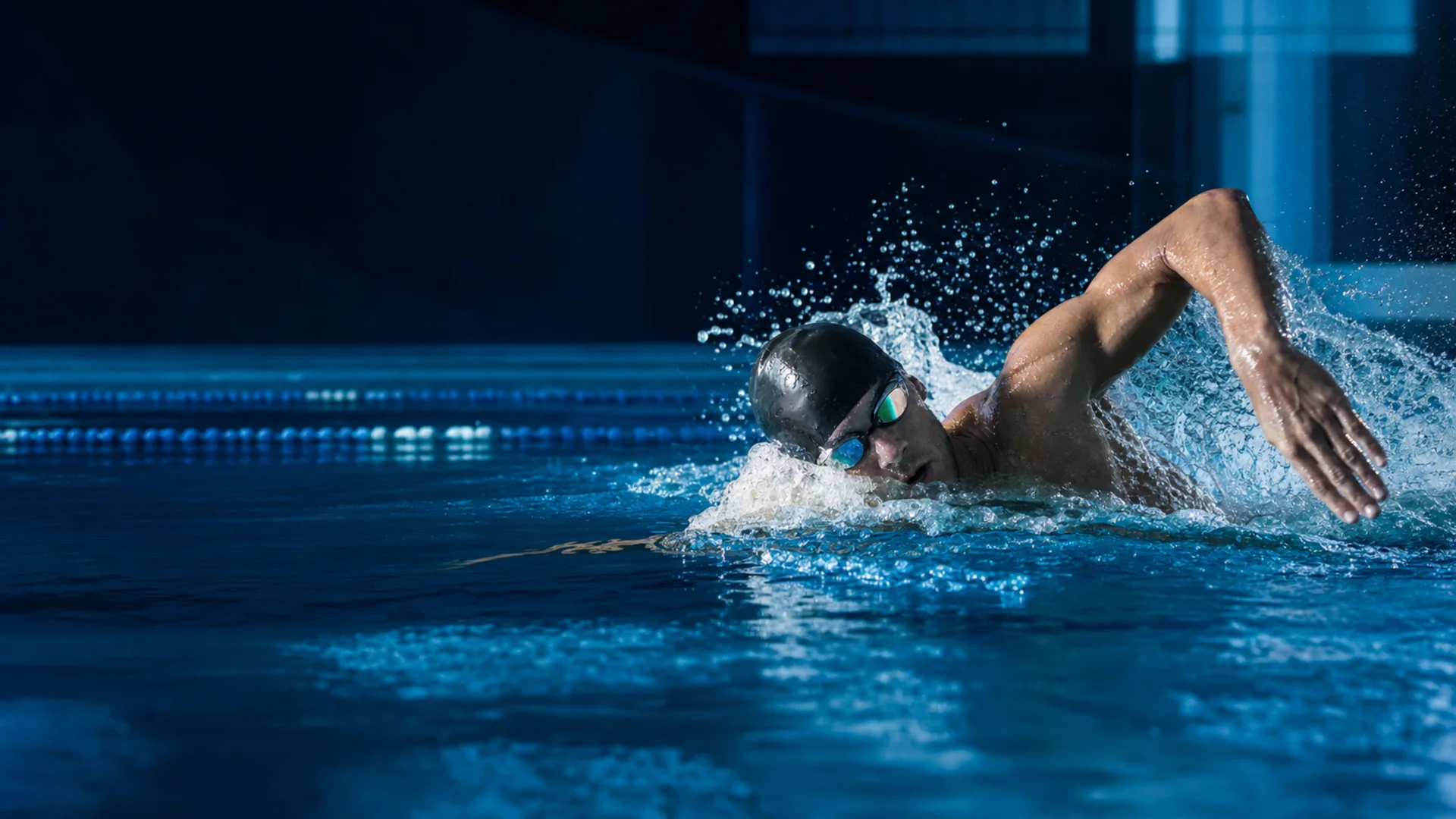
Freestyle swimmer sprinting at water level
Swimzy speed guideSpeed = stroke rate × distance per stroke
v
Cut drag first Raise the ceiling Anchor race pace Bank free speed Test, don't guess
01 · The speed equation

Two numbers
make every swim speed.

Your speed at any moment is how often you take a stroke multiplied by how far each stroke carries you. Every technique change, every session and every piece of equipment is pushing on one of those two numbers, or on the drag that holds both of them back.

Speedmetres per second
Stroke ratestrokes per minute, or the time one cycle takes
Distance per strokehow far your body travels each stroke

Why drag decides the argument

Water resistance rises roughly with the square of your speed, and the power you need to overcome it rises roughly with the cube. Swim 10% faster and you are fighting about 20% more drag with about 30% more power. That is why the fastest swimmers are not simply the strongest: they are the ones who present the least resistance at speed. Every lever below starts by asking "does this reduce drag?" before it asks "does this add propulsion?".

The trade-off to manage Push stroke rate up and distance per stroke tends to fall. Stretch distance per stroke and rate drops. Your fastest sustainable speed lives at the combination where the product is highest for the distance you are racing. That combination is different for a 50 and a 1500, which is why the same swimmer needs different stroke settings for different events.

What speed feels like in splits

Speed25 m50 m100 m1500 m
1.2 m/s20.8 s41.7 s1:2320:50
1.4 m/s17.9 s35.7 s1:1117:51
1.6 m/s15.6 s31.3 s1:0215:37
1.8 m/s13.9 s27.8 s55.6 s13:53
2.0 m/s12.5 s25.0 s50.0 s12:30
2.2 m/s11.4 s22.7 s45.5 s11:22

Pure swimming speed with no dive and no turns. Real race times are faster over short distances thanks to the start, and turns change the picture over long ones.

02 · Speed reserve

Why a 1500 swimmer
still trains top speed.

Race pace is a fraction of your maximum speed. The higher your ceiling, the smaller the fraction your race pace demands, and the cheaper every length becomes. Middle-distance runners call the gap between top speed and race speed the speed reserve. It works the same way in water.

  • A bigger reserve makes race pace feel easier. Holding 1.5 m/s is a different task when your top speed is 2.0 m/s than when it is 1.7 m/s. Same pace, lower relative effort, less fatigue per length.
  • Speed work sharpens the nervous system. Short maximal efforts recruit the fast muscle fibres and teach a crisp, high-force catch that distance swimming alone lets go soft.
  • It protects your finish. The last 100 of an 800 or 1500 is won by whoever still has a gear left. That gear is built in ten-metre sprints months earlier.
  • It costs very little time. Two short doses a week, done fresh, is enough to keep the ceiling rising while the aerobic work does the heavy lifting.
EventRace pace as % of max 25 m speedWhat mostly limits it
50 m92–100%+Ceiling, start, breakout
100 m85–92%Ceiling plus holding it
200 m78–85%Race-pace tolerance, pacing
400 m73–80%Threshold speed, turns
800 m70–77%Economy at pace, aerobic engine
1500 m68–75%Economy, pacing, the last 200

Rules of thumb drawn from elite race splits, using average race speed against a maximal 25 m push. Treat them as a compass, not a verdict. The calculator below places you on this scale.

03 · The five levers

Where top speed
actually comes from.

In this order. Each lever is worth more when the one above it is in place, and the first two are free speed for almost everyone.

1

Body line: the drag lever

Your body is the biggest object in the water. A flat, long, narrow line lets speed happen. Head in line with the spine, eyes down and slightly forward, hips at the surface, feet inside the shadow of the body. Rotate around the long axis rather than sideways, and keep the kick small enough that it stays inside that line.

DrillKick on your side with the lower arm extended and the top arm on your hip. Breathe by rotating the head only. Six kicks, one stroke, switch sides.
Cue"Swim downhill." Press the chest lightly so the hips float up. If your feet feel cold at the surface, you are there.
TestPush off in streamline and glide. Measure where you stop. Then repeat with a tight tuck of the chin and squeezed ears. The extra half metre is your drag bill.
2

Catch and pull: the propulsion lever

Distance per stroke is made in the first third of the pull. Enter in front of the shoulder, extend, then let the forearm and hand drop to point at the bottom while the elbow stays high and wide. Now you are pressing on still water and pushing the body past the hand. A hand that slips through the water gives you a high stroke count and a low speed for the same effort.

DrillSculling with the forearm vertical, then single-arm freestyle with the resting arm forward. Feel the water load on the forearm before you press.
Cue"Fingertips down, elbow up." Or picture climbing a ladder that is lying on the water in front of you.
TestCount strokes per length at an easy pace. Then swim the same pace with two fewer strokes. If you can, your catch has room to grow at speed.
3

Kick: rhythm and lift

For a sprinter the six-beat kick is a second engine. For a distance swimmer it is mostly a balance tool that keeps the hips up and the rotation timed. Either way the kick starts at the hip, travels through a loose knee and finishes with a relaxed, pointed foot. Ankle flexibility is worth more than kick effort: a stiff foot pushes water down, not back.

DrillVertical kicking in deep water, hands crossed on the chest, 20 seconds on, 20 off. Then 25 m kick with a board at max, timed.
Cue"Boil the water, don't splash it." Small, fast and inside the body line.
Test25 m max kick with a board. Sprinters want to close the gap between kick speed and swim speed. Distance swimmers want an easy two-beat kick that keeps their hips up at race pace.
4

Stroke rate and length: the tuning lever

Once drag is low and the catch holds, speed is about the setting. A tempo trainer, or a simple stopwatch count of strokes over ten seconds, lets you find the rate where distance per stroke starts to collapse. Race just below that point. Sprinters sit at a high rate and accept a shorter stroke. Distance swimmers sit lower and protect stroke length, then lift the rate in the final quarter.

Session6 × 50 at 100 pace, each 50 at a slightly higher rate than the last. Record time and stroke count. The fastest 50 with the fewest strokes is your current setting.
Cue"Same length, faster hands." Speed up the recovery and the entry, not the pull.
TestSwim golf: time in seconds plus strokes for a 50. Retest every two weeks at the same effort. A falling score is real, transferable speed.
5

Free speed: start, underwater, turns, finish

You are never faster than in the first metres off the block and off the wall. A confident dive, a tight streamline, five or six dolphin kicks and a breakout without a breath are worth more to a 50 than any single stroke change. A 1500 in a 25 m pool has 59 turns; a tenth of a second on each is nearly six seconds. The finish is a skill too: no breath in the last five metres, eyes on the wall, drive the hand in long.

Session8 × 15 m from a dive at max with full recovery, timed to the 15 m mark. Then 8 × turns from mid-pool, sprinting in and out, timed 5 m in to 10 m out.
Cue"Tight, tight, kick, kick, breakout." Hold the streamline until you feel yourself slow to swim speed, then surface into the first stroke.
TestTime to 15 m from a push and from a dive. Track underwater distance and the number of kicks. Both should trend up before you touch anything else.
04 · Event by event

What top speed means
for your race.

Same equation, different settings. Each card gives the job top speed does in that event, the pace to anchor training around, the session that builds it and the trap to sidestep.

50 m Pure ceiling

The job
Reach maximum speed by 15 m and lose as little of it as possible. Race pace is your ceiling. The start and breakout are a quarter of the race.
Anchor pace
Your best 25 m from a push, and your 15 m time from a dive.
Builder session
10–12 × 15 m max from a dive or push, two to three minutes rest, plus 4 × 25 at full stroke rate with a tempo trainer. Fresh, never fatigued.
Sidestep
Sprinting tired. Speed is a nervous-system skill. If the times drop off, the set is over.

100 m Ceiling plus hold

The job
Hit a high fraction of max speed on the first 50 and give away less than others on the second. Both the ceiling and the fade matter, so both are trained.
Anchor pace
Goal 100 time split as 50 + 50, with the second 50 no more than two to three seconds slower.
Builder session
Broken 100s: 4 × (50 + 25 + 25) at goal pace with 10 seconds between parts, three minutes between sets. Plus one weekly max-velocity dose from the 50 m card.
Sidestep
Training only the back half. Raising the ceiling makes the first 50 cheaper, which is what protects the second.

200 m Speed with tolerance

The job
Hold roughly 80% of max speed for four lengths of a 50 m pool or eight of a 25 m one. Pace discipline, stroke length under acid and seven fast turns in short course.
Anchor pace
Goal 200 time divided by four: your 50 race pace.
Builder session
12–16 × 50 at 200 race pace on 20–30 seconds rest, stroke count held constant. Stop the set the moment two 50s in a row miss pace. Speed reserve dose: 6 × 15 m max, once a week.
Sidestep
Going out too hard. The first 50 should feel controlled and land about a second faster than the others, not three.

400 m Threshold with a ceiling

The job
Sit just above your critical swim speed for the whole race. The higher your top speed, the lower the fraction that pace demands, and the more relaxed your stroke can stay through the middle 200.
Anchor pace
Goal 400 time divided by four as 100 pace. Cross-check against your critical swim speed.
Builder session
8 × 100 at 400 pace on 15–20 seconds, then 4 × 50 at 200 pace. Weekly speed dose: 6 × 25 build to max, walk back.
Sidestep
Letting stroke count creep up as you tire. Count on lengths three, seven and eleven. Same number is the goal.

800 m Economy at pace

The job
Around three quarters of your max speed, held for eight to ten minutes. Economy wins: the least drag and the longest stroke you can hold at rate, with a two-beat kick that keeps the hips up for free.
Anchor pace
Goal 800 divided by eight as 100 pace, with the last 100 planned faster than the middle ones.
Builder session
3 × (4 × 200) at 800 pace on 20 seconds, one minute between rounds. Plus a weekly speed dose: 8 × 12.5 m max off the wall, easy back.
Sidestep
Only ever swimming steady. Race pace and top speed are separate skills, and the aerobic base does not replace either.

1500 m Efficiency plus a last gear

The job
Roughly 70% of max speed for a quarter of an hour, then a change of gear with 200 to go. Turns are a race within the race: 29 of them long course, 59 short course.
Anchor pace
Goal 1500 divided by fifteen as 100 pace. Even splits through 1300, then the finish.
Builder session
15 × 100 at race pace on 10–15 seconds, stroke count logged every fifth 100. Turn set: 12 × 50 with a max effort five metres in, five metres out, easy in between. Weekly speed dose as for the 800.
Sidestep
Wasting the last 200. Practise lifting the stroke rate on the final 100 of every long set so the gear change is rehearsed, not hoped for.
05 · Speed reserve calculator

Is speed or endurance
your limiter?

Two numbers you can collect in one session. Your race pace as a fraction of your top speed tells you which end of the equation to work on first.

Enter a 25 m sprint time and a valid event time.
Your speed profile100 m
—top speed, m/s
—race speed, m/s
—race pace as % of top speed
60%typical band for this event105%

Fill in the form to see where you sit. Nothing is stored or sent anywhere.

Want this done for you? The Tailored Speed Guide turns your 50 m time, your week, your gym and your goal into a four-week programme, pool and land, with every session written out. Twenty-four questions, PDF within a minute, £10.99.
Build my tailored guide
06 · Weekly structure

How a speed week
fits around real life.

Three or four swims a week is plenty to move top speed. The mix changes with the event, but every group keeps a max-velocity dose, a race-pace anchor and one session that leaves the stroke better than it found it.

IngredientSprint · 50 / 100Middle · 200 / 400Distance · 800 / 1500
Max-velocity work
10–25 m, full recovery, fresh
2 sessions, 300–500 m of max effort each1 session plus a short dose in another, 200–300 m total1 dose of 100–200 m total, early in a session
Race-pace work
at goal speed, short rest
1 session: broken 50s and 100s2 sessions: 50s and 100s at race pace2 sessions: 100s and 200s at race pace
Aerobic base
steady to threshold
1 short session, mostly technique at low rate1–2 sessions around critical swim speed2 sessions, one long, one at threshold
Skills
starts, underwater, turns, finish
In every session, 15–20 minutesTwice a week, 10 minutesTurn work weekly, breakouts in every warm-up
Dryland power2 × 40 minutes: jumps, med-ball throws, pull-ups, hip hinge1–2 × 40 minutes: same menu, lower volume1 × 30 minutes: pulling strength, trunk, ankle mobility
Where the speed session sitsFirst in the week, after a rest dayBefore the hardest race-pace dayNever after the long swim; day one or two of the week
Want the sprint version done for you? The 7-Day Sprint Lab turns your 50 m or 100 m times, stroke count and pool into five ready-to-swim sessions and a retest.
07 · Tests to track

Five numbers
that tell the truth.

Retest every two to three weeks under the same conditions: same pool, same point in the session, same rest. The trend matters more than any single result.

1

25 m max from a push

Your ceiling. Feed it into the calculator above. Note the stroke count with it.

2

15 m from a dive

Start plus underwater plus breakout. The cheapest time on the clock for any sprinter.

3

Swim golf 50

Seconds plus strokes at a hard but controlled effort. Measures whether speed is coming from efficiency or effort.

5

Turn split

Five metres in to ten metres out, from a marked line. Track it for every stroke you race.

08 · Fast upgrades

Changes that pay
within a fortnight.

  • Breathe less in the fast bits. No breath on the breakout, none inside the flags, and an every-three or every-four pattern in a 50. Each breath you skip keeps the body line flat.
  • Finish the streamline. Hold it a metre longer off every wall this week and count the kicks. Most swimmers surface early out of habit, not need.
  • Time your rest. Speed work needs two to three minutes between efforts. Race-pace work needs ten to thirty seconds. Mixing them up trains neither.
  • Anchor a stroke count. Pick the count you hold at race pace and swim every race-pace repeat at it. Speed with a rising count is borrowed.
  • Sprint fresh, once a week, forever. The single best habit for any distance. Ten minutes, early in a session, fully recovered.
  • Film one length a month. Above water from the side is enough to see the body line, the entry and the breath. What you feel and what you do are rarely the same thing.
Swimmer leaving the blocks at the start of a race
The start and the first 15 m are the fastest you will ever move in a race. Practise them like a skill, not a warm-up.
Train hard, keep it sensible Maximal swimming asks a lot of the shoulders and the heart. Warm up properly, stop if you feel pain or unusual breathlessness, and check with a professional first if you have a condition that makes all-out effort a question. This guide is educational, not medical advice or a substitute for a coach on deck.
Take it further

Know exactly which lever
is yours to pull.

Answer some quick questions about your 50 m time, your week and your gym, and get a four-week programme built around them, pool and land, as a PDF within a minute.

Tailored speed guide£10.99

Time budget · four weeks of sessions · gym plan · tests

Build my tailored guide

Or book a £29 stroke analysis →